
Summary
Money in politics is as American as apple pie and tossing the pigskin, but its sheer size and impact would boggle an onlooker’s mind. When you show the size of total spending on advertisements in 2024, it looks almost comical: $11,200,000,000.
That number may not surprise Americans, given that it was regarding a hotly contested presidential election between Donald Trump and then-Vice President Kamala Harris. But this midterm season is shaping up to be the most expensive cycle ever, despite midterm cycles often capturing less money and attention than presidential cycles.
Projections show that by November 3, this year’s races are projected to reach $11.6 billion in ad spend. But where is all of this money coming from, and who is benefitting the most from the wild west that is campaign finance?
Analysis
When looking at that aforementioned $11.6 billion number, it is hard to grasp where that money is actually coming from. Most of the 2026 data is either still coming out or subject to change now that the general elections are heating up, so much of the data will be projections for 2026 or based on 2024 FEC filings.
There are a lot of avenues that money flows into politics, so I will be breaking it down into four categories: political party committees, PACS, individual donors, and corporate donors. There is a fifth category, but it is best saved for its own article.
Let’s start with the political parties themselves. After a recent Supreme Court decision striking down limits on coordinated campaign expenditures, the floodgates have opened for the financial arms of both the Democratic and Republican parties.
In total, political party committees on both sides have raised $1.1 billion in federal funds as of March 31, 2026. This is actually less than half of what they spent in 2024, when the figure hit $2.6 billion. Generally speaking, Republican committees have managed to raise more than their Democratic counterparts. That trend has continued in 2026, where Democratic committees have raised $540.1 million compared to the $574 million for Republicans.
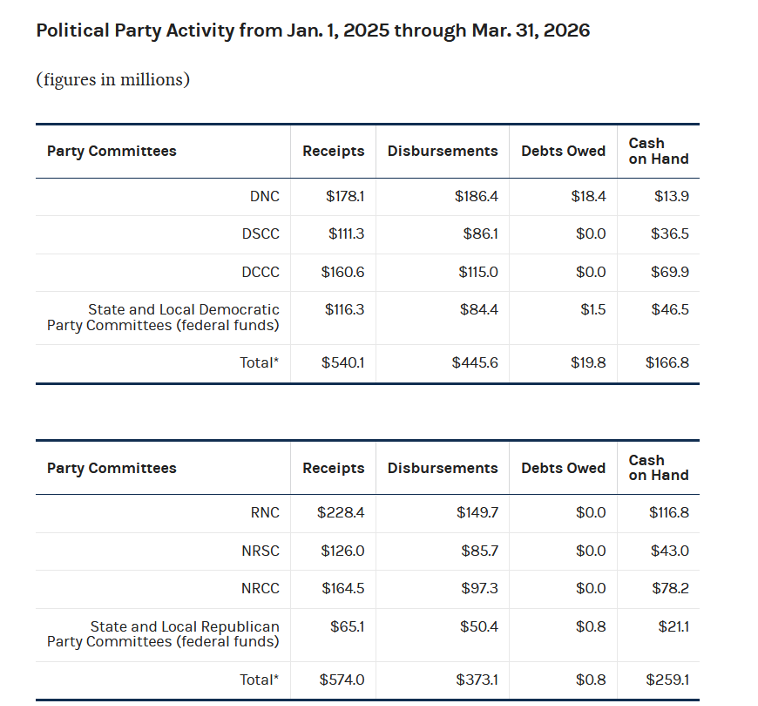
According to data from the Federal Election Commission
While there are certainly concerns about money being spent by parties directly on candidates, it is arguably the least controversial avenue for fundraising. There isn’t much of a story in this arena yet besides that recent SCOTUS case, but it is a helpful baseline to compare the next four categories of fundraising to. Let’s move onto the next one: PACs and Super PACs.
Looking at the biggest PACs in 2024, many of the names represent industries or trades and sit unaligned on the political spectrum. The National Association of Realtors is a prime example; they raised the second most out of any PAC at $4.19 million and split that money 50-50 between Democratic and Republican campaigns in 2024.
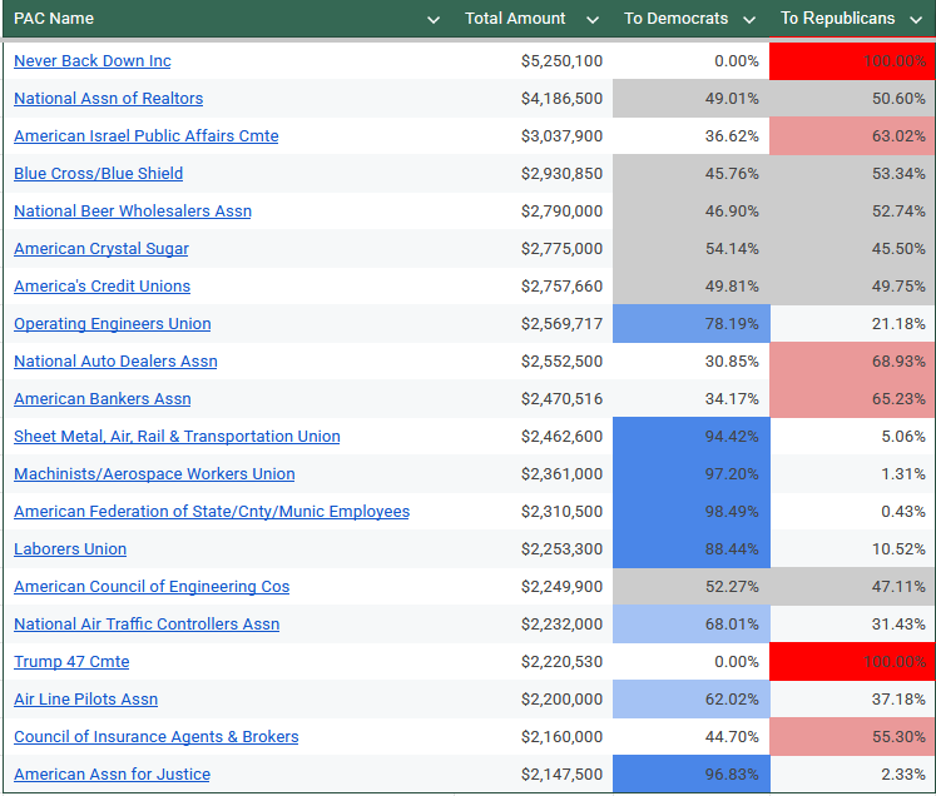
Data pulled from OpenSecrets database, 2024
Others, like the National Beer Wholesalers Association, America’s Credit Unions, American Crystal Sugar, all had similar splits with top-10 fundraising numbers. But there are some big name exceptions you surely have heard of.
The American Israel Public Affairs Committee (AIPAC) raised the 3rd most in 2024 at just over $3 million. Their donation split leaned 63% to Republican candidates, but at first glance that seems shockingly small for a PAC that has amassed so much attention this cycle. This is because it has a host of affiliated Super PACs and other affiliated PACs to spread the load. All in all, analysis shows that in 2024 they spent $46 million across the board, a number that has already jumped to $67 million this cycle already. One race has attracted the most money by far.
AIPAC and its affiliates spent $30 million backing Michigan Senate candidate Haley Stevens against progressive challenger Abdul El-Sayed. And while they failed, that is the most they have ever spent on a single race.
So far, it might seem that the biggest PACs are apolitical or issue-based with a slight political preference, like with AIPAC. But Ron Desantis’ Never Back Down Inc. is a conservative PAC that raised the most in 2024 at $5.25 million. Democratic leaning PACs also top the charts: the Machinists/Aerospace Workers Union, American Federation of State/County/Municipal Employees, and Laborers Union overwhelmingly leaned blue.
But again, most of the money thus far has leaned Republican slightly. The political parties’ spending was pretty evenly matched, and most normal PACs focus on specific issues rather than aisles. When looking at Super PACs, the story changes drastically.
According to Tech Influence Watch, the top four Super PACs in the 2026 cycle have been SLF PAC (supports Senate Republicans), Fairshake Crypto, SMP, (supports Senate Democrats), and Democracy PAC (George Soros’ pro-Democrat PAC). That last pac is notable because it is often one of the biggest Democratic allies. In 2024, it raised $71.6 million, and so far in 2026 it has raised $102 million
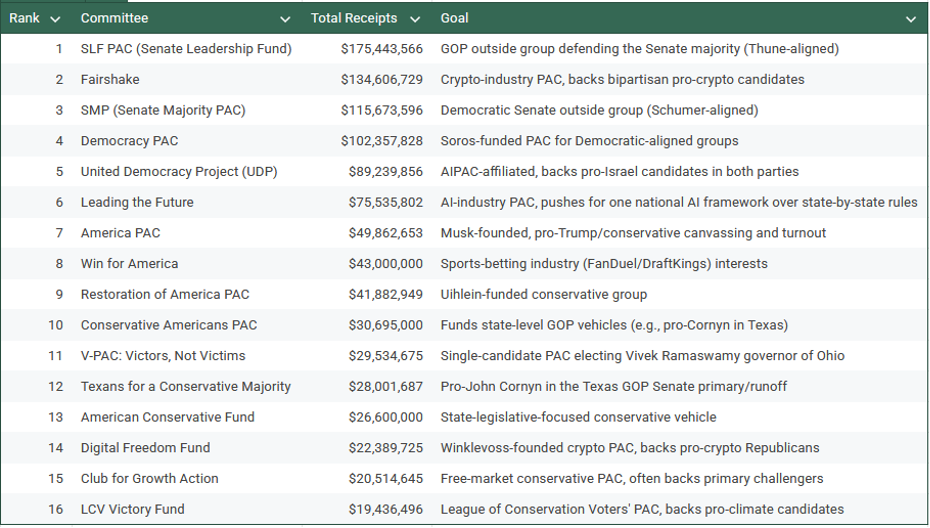
Data pulled from FEC filings and cross-referenced with Tech Influence Watch’s database, 2025-2026
After that, there is the AIPAC-affiliated United Democracy Project, and then a slew of pro-AI, pro-crypto, pro-gambling, and pro-Republican Super PACs for the next 15 slots.
When looking at that list, it is hard not to see who money in politics is helping. Cryptocurrency, sports gambling, and AI companies all have massive influence on politics, and most of them have been backing Trump-aligned causes because of his dedication to deregulating their respective industries. On top of that, the fact that there are more than three times the number of Republican Super PACs than Democratic ones in the top 20 is one that should raise some eyebrows.
The story continues onto our next section: individual donors.
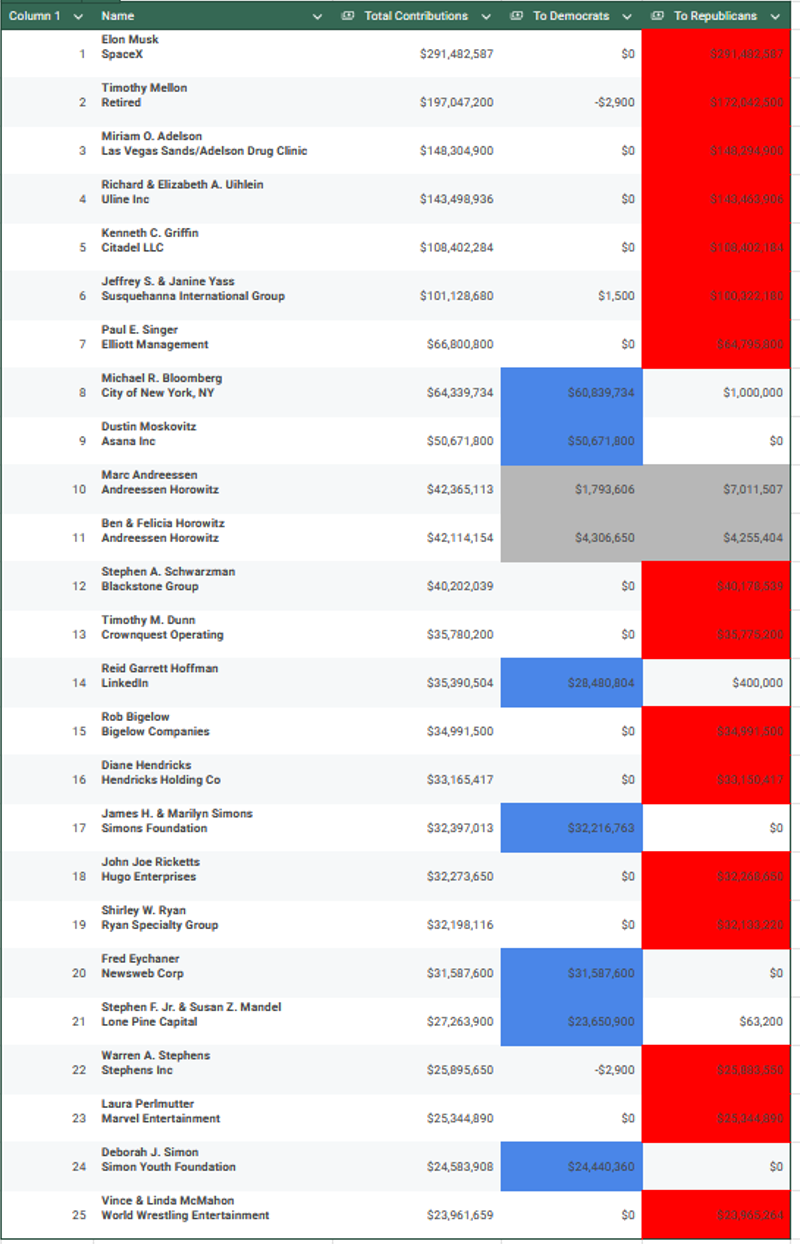
In the 2024 election, the biggest individual donor was Elon Musk, who made headlines when he pledged $260 million to get Trump elected, even handing out $1 million checks to prospective voters. While his 2026 numbers are not done yet, he has already authorized his super PAC to spend upwards of $120 million to help Republicans maintain control of Congress.
Data pulled from Open Secrets database, 2024
The next six largest donors in the 2024 election all backed Donald Trump. Timothy Mellon, heir to the Mellon family fortune, spent over $172 million to support Trump. Miriam Adelson, megadonor and casino magnate, gave $148 million. Richard and Elizabeth Uihlein, Republican megadonors and owners of the business supply company Uline, gave $143 million.
Then there’s hedge fund CEO Kenneth C. Griffin at $108 million, Wall Street mogul Jeffrey Yass at $100 million, and another hedge fund CEO, Paul E. Singer, at $68 million. Finally, you get to the first Democratic donor, Michael Bloomberg, at just around $60 million. There are some more familiar names further down the list, such as Vince and Linda McMahon, but these top 7 names are the true heavy hitters.
Again, lots of red-leaning names of people who have a vested interest in candidates focusing on pro-business and deregulation. Some reports have found that billionaires have already poured $433 million into the 2026 midterms, with 80% of it going to Republicans.
Additionally, Linda McMahon’s name is a huge red flag, given that she is now the United States Secretary of Education. But quid-pro-quo politics in the Trump age is the rule now, not the exception.
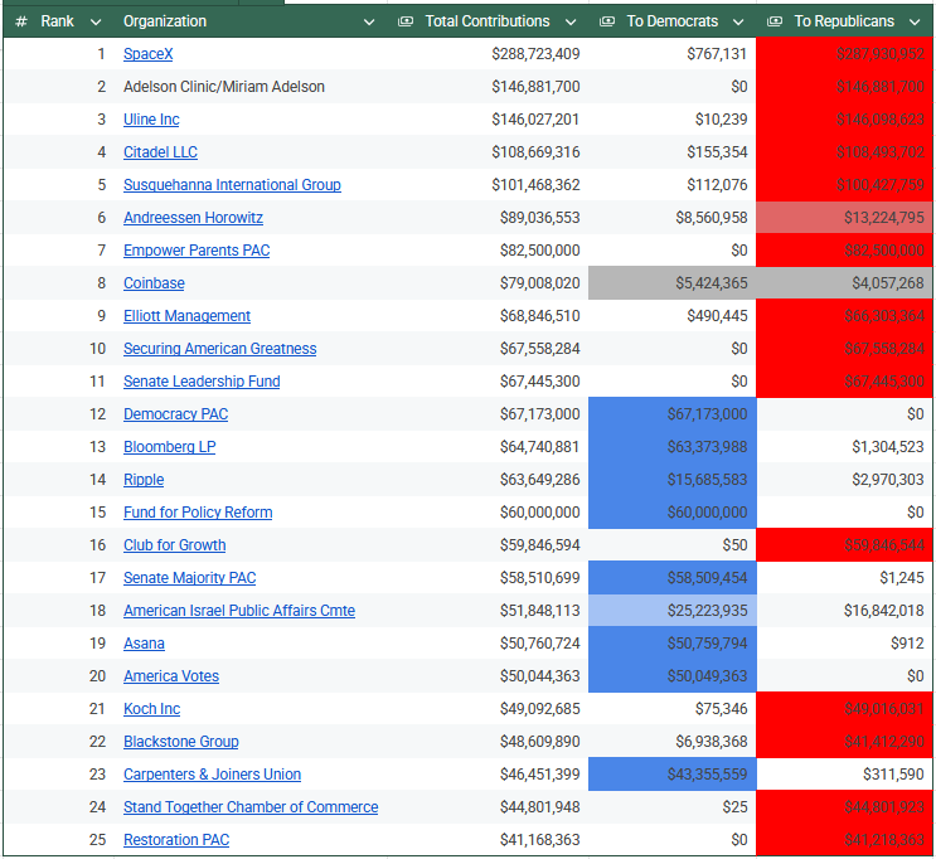
Now, what about corporations’ direct contributions? After all, their donations are the ones most critics will point to when a politician is deemed to be “bought out” by outside interests. This is where things begin to get a little interesting, as most of the top corporate donors match 1:1 with the individual donors and mirror the Republican leaning of the biggest PACs.
Musk’s SpaceX tops the list, followed by Adelson Clinic, Uline Inc, Citadel LLC and Susquehanna International Group (which are the two hedge funds of Kenneth Griffin and Paul Singer). On this list, however, the top 11 are almost all Republican-aligned, save for the crypto company Coinbase (we will get back to them later). Additionally, the amounts are on par with the size of the individual donations mentioned earlier.
Data pulled from Open Secrets database, 2024
But this list covers the 2024 election. When looking at this midterm cycle, the growth in corporate donations is astonishing. According to a report by Public Citizen, “nearly one third of all corporate political spending on elections since the 2010 Citizens United decision has occurred in the current election cycle”.
In the 2026 election cycle, corporations have spent $517 million already, and that number is expected to exponentially grow going into November. The 2024 cycle had $461 million in corporate spending, a number expected to grow throughout the final months of election season.
One final interesting fact on corporate donations is notable here. While most focus on Republican causes, the split has actually begun shifting more towards Democrats of late.
In 2020, corporate donations by business PACs direct to candidates was split 60-40 in favor of Republicans. This is different from the above split where those donations could go to technically unaligned ads that support a candidate implicitly in order to avoid some FEC rules. But in 2022 that split changed to 57-43, and then in 2024 it became 55-45.
Additionally, while many big tech PACs, CEOs, and companies back Republicans, tech employees remained overwhelmingly Democratic. Upwards of 98% of Twitter employees alongside 86% of Tesla employees donated to Democratic causes.
So what can we glean from all of this information? Well, when looking at publicly reported donations, it seems that most of the money going into politics is backing Republicans. This is nothing new, as their platform has generally been pro-business and the Trump administration has gotten very cozy with the wealthy and influential tech giants with the rise of cryptocurrencies and AI.
But what is new is the sheer size of donations that continue to flood the airwaves. It is constantly growing each cycle, and records continue to be broken on the donation and spending fronts.
Additionally, PACs that are relatively new, such as Ron Desantis’ 2023 PAC, have quickly amassed so much influence as to be amongst the biggest donors in a cycle. How such a quick rise to power is accomplished is up for debate, whether it be due to incredible networking, coordination with party donors, or simply luck. If this is the new normal, then new industries and players can quickly flex their financial muscles upon going public or receiving a new contract.
Finally, while the richest donors lean to the right of American politics, it seems that the next richest tier seems to be giving ever slightly more money to Democratic causes, based on those 55-45 splits for corporate donations.
Whether this is simply them seeing the writing on the wall in the midterms, given the chances of a blue wave, or a genuine realignment is up for debate. After all, Democrats have never been without corporate donors and it is hard to argue that they have been hostile to wealthy businesses.
That being said, this is all according to what is public knowledge. There is a whole other arena of financial donations hidden beneath the surface, in a world filled with what is called “dark money”. While what is found there is fascinating and terrifying, it is worthy of its own brief.
For now, ensuring that people know who is funding their parties and candidates is the first step towards fixing corruption in government. No one donates money without a reason, and the more money donated often means the more influence one wields or wants to wield. And those that want to wield influence are rarely the same ones that are looking out for the average American.
Take Action
- The Brennan Center for Justice is an American liberal nonprofit law and public policy institute focused on Democratic and justice-related reforms.
- End Citizens United is a single-issue grassroots PAC focused entirely on overturning Citizens United and countering the influence of dark money in elections.
- OpenSecrets is a premier nonpartisan, independent nonprofit organization that tracks and publishes comprehensive data on money in American politics.