
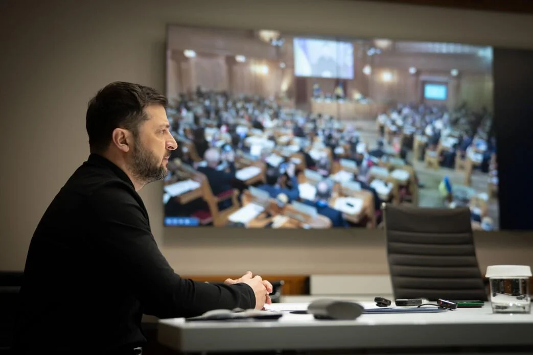
President Zelenskyy addressed the Swedish Parliament on Monday morning. www.president.gov.ua
Ukraine Peace deal?
Ukraine’s government has agreed to the core parts of a peace deal brokered by the Trump administration to end the now nearly four year long war. US officials have been meeting with both the Russians and Ukrainians in order to secure an end to the war. The plan was presented as a 28 point peace plan but upon revision by the Ukrainian side has been revised to a 19 point peace plan that no longer includes items such as amnesty regarding acts committed during the war. Ukraine as part of the deal has agreed not to increase the size of its military and will not join NATO under the updated plan.
However, the main criticism of the proposed plan is the legitimation of Russian control over captured Ukrainian territory in Dobas and does not have popular support from Ukraine or its European allies. European officials have called for the inclusion of a demilitarized zone and the inclusion of an article of defense for Ukraine similar to NATO’s article 5 which calls for mutual defense of all members. The Ukrainian President, Volodymyr Zelenskky recently stated as part of whether he would accept succeeding territory to Russia, “Are we considering giving up any territory? We have no legal right, under Ukrainian law, under our constitution, under international law, and honestly, we have no moral right, either”. Meanwhile, Russian President Vladimir Putin warned that Ukrainian troops must withdraw from Ukraine’s eastern Donbas region or Russia would seize it, rejecting any compromise over handing captured territory back to Ukraine and throwing a wrench in any prospects for peace that require concessions from the Russian side over captured land.
Escalating tensions between the US and Venezuela
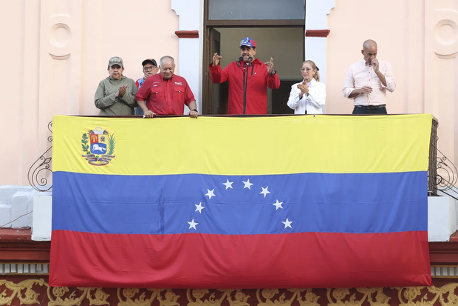
Venezuelan President Nicolas Maduro addresses a crowd flanked by Interior Minister Diosdado Cabello (left) and his wife Cilia Flores during a rally in Caracas, Jan. 23, 2025.
Pedro Rances Mattey/Anadolu/Getty
Amid the buildup of US military forces in the Caribbean the Trump administration has now moved to designate Cartel de los Sols as a foreign terrorist organization (FTO) with Nicolas Maduro as the head. The new designation by the Trump administration is thought to be another indication that the administration is seeking to conduct strikes inside of Venezuela. Secretary of War/Defense Pete Hegseth recently said the FTO designation “gives more tools” to the Defense Department and “gives options” to the President.
The “Cartel de Los Soles” or Cartel of the Suns is a term used to describe groups within Venezuela’s armed forces implicated in a wide range of criminal activities, including gasoline smuggling, illegal mining, drug smuggling and other corruption schemes. It has only recently been used to describe an official formal drug cartel. Labelling an organisation as a terrorist group gives US law enforcement and military agencies broader powers to target and dismantle it. Over the last few days the Trump administration has declared the skies over Venezuela closed and airlines have halted flights in and out of the country. The Maduro government has criticized the moves by the US and dismissed drug trafficking accusations. Venezuela’s foreign ministry stated that it absolutely rejected the designation, which it describes as a “new and ridiculous lie”. Last week for the first time the US seized an oil tanker off the coast of Venezuela and President Trump has repeatedly raised the likelihood of US military intervention in Venezuela.
Deadly Floods in Asia
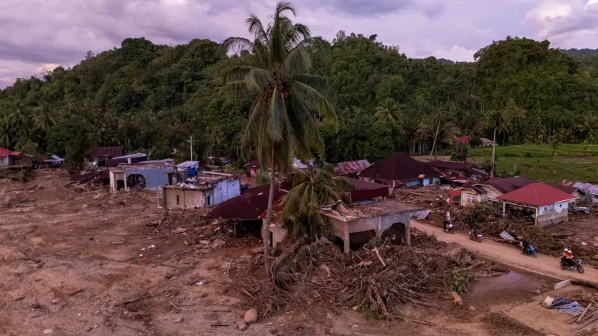
A drone view of an area hit by deadly flash floods following heavy rains in Palembayan, Agam regency, West Sumatra province, Indonesia [Willy Kurniawan/Reuters]
Catastrophic floods and landslides have hit multiple countries leaving over a thousand dead and hundreds more missing. Indonesia, Sri Lanka, Malaysia and Thailand have all been affected, with over 800 people reported missing and more than 1,400 declared dead. In Indonesia, the worst-hit country, washed-out roads and collapsed bridges have left rescuers struggling to reach some of the hardest-hit areas in North and Western Sumatra. Though unlike middle income countries such as Indonesia or Thailand, Sri Lanka has been less able to react to the floods devastation. Sri Lanka’s Prime Minister, Harini Amarasuriya, met with diplomats from the region to appeal to them to support the country’s relief and reconstruction efforts. Countries such as India, Pakistan and the United Arab Emirates have launched efforts to provide aid.
Three Typhoon storms hit the region in quick succession, Typhoon Koto which moved from the Philippines towards Vietnam, Cyclone Senyar, a rare storm that spun up in the narrow Strait of Malacca and lashed Indonesia, Malaysia, and southern Thailand and Tropical Cyclone Ditwah, which crossed Sri Lanka and India’s south-east coast. All of these storms in unison cause the massive flooding and loss of life witnessed in recent days. Water temperatures are reported to be warmer than normal in the region, warmer ocean temperatures provide more energy for storms. Climate scientists expect the frequency and ferocity of these storms to be a new normal.
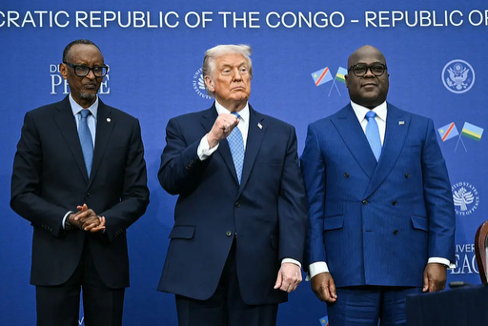
Congo-Rawanda peace deal
U.S. President Donald Trump gestures as he hosts the signing ceremony of a peace deal with the President of Rwanda Paul Kagame (L) and the President of the Democratic Republic of the Congo Felix Tshisekedi (R) at the United States Institute of Peace in Washington, DC, on Dec. 4, 2025. Andrew Caballero-Reynolds—AFP/Getty Images
Last week, President Donald Trump hailed a “historic” peace deal dubbed the “Washington Accords for Peace and Prosperity” between the Democratic Republic of Congo (DRC) and Rwanda. The deal brokered by the US and Qatar is a reaffirmed commitment to a US brokered deal signed in June which itself had failed to quell fighting. The two nations have had brewing conflicts over the past 30 years, but the violence sharply escalated in early 2025 after Rwanda-backed M23 rebels seized large parts of mineral-rich eastern DRC. The Trump administration has spearheaded talks between DR Congo and Rwanda, hoping that resolving the fighting would allow the US to increase investments in the resource rich region. However, even after the signing of the deal deadly clashes have marred efforts to begin implementing the terms of the agreement. The United States has accused Rwanda of fueling the instability and continued fighting. More than 400 civilians have been killed following the recent surge in fighting as the Rwanda-backed M23 armed group continues its offensive in South Kivu province in the eastern DRC.

Australia social media ban for minors
The teen social media ban will come into effect for some platforms today. (ABC News: Lindsay Dunbar)
Australia has become one of the first countries in the world to ban social media platforms from allowing children 16 and under from having accounts. While the law officially kicks in on December 10, Meta has already begun removing Instagram, Threads and Facebook accounts in order to comply with the new law. At the time of writing, the law applies to only ten major sites and platforms Facebook, Instagram, TikTok, Snapchat, X (formerly Twitter), YouTube, Reddit, Twitch, Kick and Threads. These companies, should they fail to comply with the removal of underaged accounts, would face fines of up to 50 million Australian dollars or $33 million USD.
The companies have been provided with a number of options for determining the age of users, the most common being an online scan of a users ID such as a drivers license. The Australian eSafety Commissioner will be sending the 10 platforms notices on Dec. 11 demanding information on the numbers of accounts removed. The Malaysian government has followed suit and said it would also ban social media accounts for children younger than 16 starting in 2026. Additionally the European Commission, France, Denmark, Greece, Romania and New Zealand have all also expressed interest in setting a minimum age for social media.