
Summary:
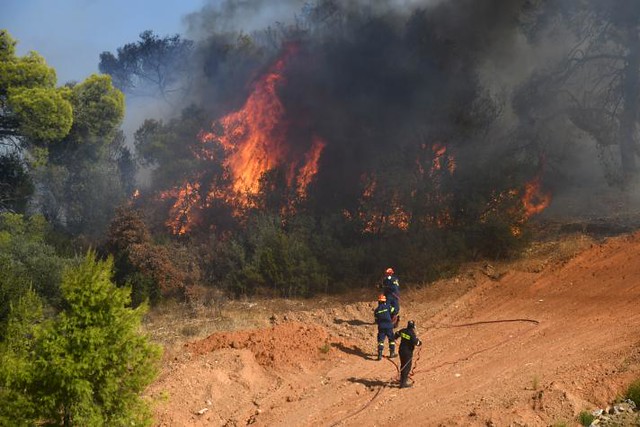
Record-breaking heat and extreme fire activity made this year one of Europe’s worst wildfire seasons in recent history. 1840 fires have burned over 634,473 hectares in the EU so far, more than double the average of the last 20 years, leading to thousands of evacuations across the continent and at least 14 deaths.
Wildfires have reached every country in Europe this year, except Luxembourg and Malta. All 42 other European countries experienced at least one wildfire, with some experiencing their worst year in the past decades.
In France, 356 fires have already burned 105,145 hectares (around 259,819 acres), making this their worst wildfire year in the past 20 years. The next-worst year for France was 2022, with 66,337 hectares burned (163,922 acres). Belgium and Slovakia are also experiencing their worst fire years in the past 20 years.
In Spain, 427 fires have burned 242,102 hectares (598,247 acres) so far, and in Italy, 492 fires have burned 110,236 hectares (272,399 acres).
Analysis:
The increase in wildfire activity around the globe is largely due to warmer temperatures and drier environments. As the climate crisis worsens, temperatures will continue to increase and precipitation will decrease. Less snowfall during winter means less water is being stored in the ground, increasing the chances of a spring or summer drought, which can help wildfires start or spread.
This year, Western Europe experienced its hottest June and July on record, and low precipitation led to record-low water levels for many major rivers, including the Rhine in Germany and the Danube in Hungary. It was so hot that thousands of people died from heat-related deaths.
A study shows that anthropogenic climate change—long-term alterations of the Earth’s climate directly related to human activity—is already increasing wildfire risk across Europe. That risk will continue to rise in the coming decades. The study found that even if we were to create a low-carbon emission scenario, the annual burned area in Europe could still increase by 39% due to intensified fire weather alone, and by 192% in a high-emission scenario.
Not only does climate change cause more wildfires, but wildfires also accelerate climate change. As fires burn through forests and human-made wooden objects, all the carbon stored in those objects and organisms is released into the atmosphere. Wildfires can also damage the soil’s deep layers, where 69% of the carbon stored in forest is. All this carbon being released into the atmosphere leads to higher temperatures, further increasing climate change. What’s left behind after the wildfires are young, small forests that have a much lower ability to sequester carbon. According to the World Wildlife Fund, “vegetation reaches its full sequestration ability after 25 to 250 years of growth. As fires burn more frequently, the opportunity for plants to reach that full potential becomes less likely.”
Nearly every country across Europe and North America has seen an increase in the number of wildfires or area burned by wildfires in the past 20 years. Just last year was the EU’s worst wildfire year on record, and this year is almost as devastating. Unless climate change is adequately addressed and mitigated, wildfire damage will continue to increase.
Take Action:
https://time.com/article/2026/07/29/europe-wildfires-france-spain-victims-how-to-help/ Resources to help the victims of Europe’s wildfires.
https://www.c2es.org/document/resilience-strategies-for-wildfire/ Learn how to reduce the likelihood and impacts of wildfires on your home.
https://efi.int/article/wildfires-are-europes-new-normal-why-we-urgently-need-act Read more on forest management practices to reduce wildfires.