
Summary
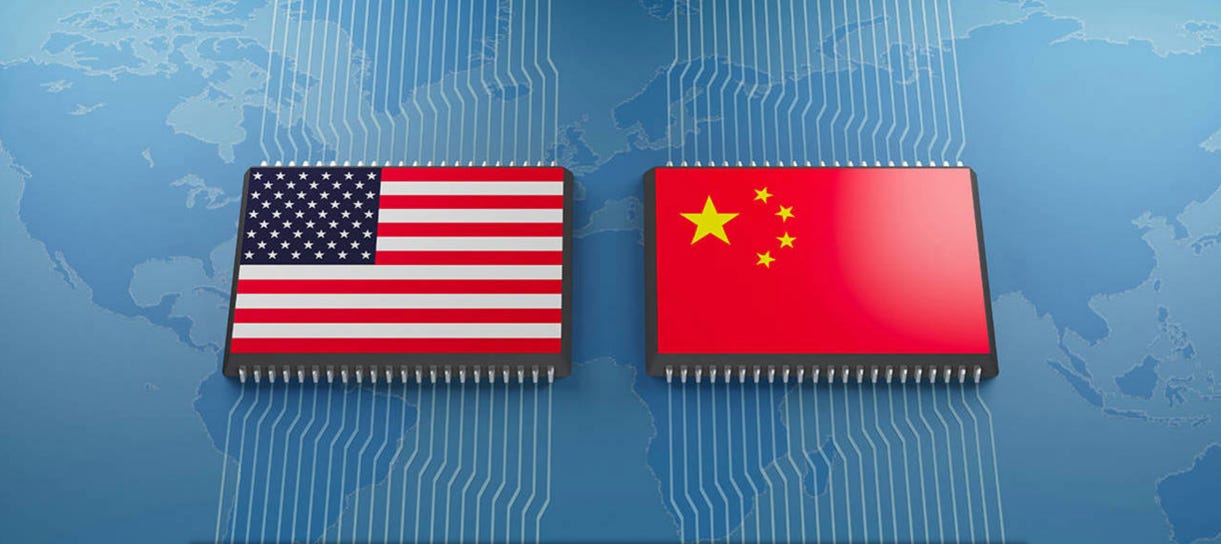
The United States is racing China for the most advanced AI chips. Washington frames the race as a contest over technology and national security. It is also an industrial build-out that consumes electricity, water and chemicals at scale in both countries.
The CHIPS Act set aside $39 billion for semiconductor manufacturing. That money helps companies build fabs, the factories that make chips. The data centers that run AI systems then draw on local power grids and water supplies.
Washington tracks investment and output. It tracks far less of what the factories take from their surroundings, what the work does to the people inside and who pays the power bill. This brief explains what the race is, where it is heading and how it can be regulated.
Analysis
What the race is. The AI race is a contest over who builds and controls the computing power behind advanced AI. That power comes from specialized chips and the data centers that run them. Washington pulls two levers. Export controls restrict sales of advanced chips to China. The CHIPS Act pays for chip manufacturing at home. Private money does the rest. Amazon, Alphabet, Meta and Microsoft plan to spend about $725 billion on capital projects in 2026, up 77 percent from 2025.
Where it is going. The build-out is still accelerating. Alphabet’s finance chief says capital spending will rise significantly in 2027. U.S. data centers used an estimated 183 terawatt-hours of electricity in 2024, more than 4 percent of the national total. Lawrence Berkeley National Laboratory projects 426 terawatt-hours by 2030. Bank of America analysts estimate the country needs more than 230 gigawatts of new generating capacity over five years, while utilities are expected to add about 93. The strain is already visible. Data center growth is delaying coal plant closures, and New York has imposed the first statewide moratorium on large projects. Shortages of skilled labor and equipment and local opposition are slowing others.
What it costs. Start with water. Chips are rinsed repeatedly in ultrapure water, water stripped of nearly every impurity. A Commerce Department review found the median fab among 29 studied used about 4.25 billion gallons of it in 2021, roughly 11 million gallons a day. The same review says newer chip designs need more tools, more cleanroom space and more water per wafer. Commerce concluded that expansions at existing fabs generally will not cause significant harm. The department can write fixes into award terms, but only where it chooses to. Data centers add a second draw. They directly consumed an estimated 17 billion gallons in 2023, and that could double or quadruple by 2028.
Workers face a different gap. OSHA has said many chemicals in the industry lack established exposure limits, and it has no standard written for chip fabs. Workers building TSMC’s Phoenix plant alleged unsafe conditions in 2023, though state inspectors found few violations. The Biden administration asked CHIPS applicants for child-care and workforce plans. In June 2025 Commerce Secretary Howard Lutnick said the department was renegotiating awards. Intel’s revised deal, which gave Washington an equity stake, lifted some workforce requirements.
Power is the third cost. PJM, the grid operator for 13 states and Washington, D.C., runs auctions that pay power plants to stay ready for peak days. Its independent market monitor estimates data center demand added $23.1 billion to costs across three auctions. That is revenue to suppliers, not a line on each bill, and other factors also lifted prices.
How it can be regulated. Washington regulates the race mainly by deciding who may buy chips. It regulates far less how chips and data centers get built. Three layers could close the gap.
The first is federal money. CHIPS awards were designed to be paid in installments tied to benchmarks, which gives Commerce a lever over funds not yet released. The second is federal rules, from EPA reporting to OSHA exposure limits. The third is states and utilities, where most data center costs reach households. The Kansas Health Institute found states mostly address energy reporting, ratepayer protection and environmental assessment, while local governments act on zoning and permits. Jurisdiction is contested. FERC recently rejected most of PJM’s plan for large loads, saying it intrudes on state jurisdiction. Supporters of faster permitting say delay hands China an advantage. The question is whether speed must come at the expense of the people nearby.
Five changes that tie AI subsidies to the people who bear the costs
- Attach wage, safety and apprenticeship standards to chip subsidies. Commerce can write labor conditions into awards not yet paid.
- Require disclosure. Recipients should report water use, chemical discharges and emissions for each fab.
- Require independent assessments before final approval. Commerce’s own review covers fabs in general. An outside review would test each site, starting with the local water supply.
- Protect workers who handle hazardous chemicals. OSHA can set exposure limits for chemicals that lack them. Employers can adopt the stricter limits OSHA already encourages in the meantime.
- Make data centers prove households will not pay for them. Developers receiving federal incentives should show that power and water costs stay off household bills. The Senate’s permitting bill would make data centers above 20 megawatts pay for the grid costs they add. Brief #173 covers that fight.
America cannot claim to be building a cleaner, stronger industrial future if the workers and communities making it possible are left carrying the costs.
Take Action
- NIST environmental assessment: Read its water, chemical and worker-safety findings.
- Kansas Health Institute report: See projected energy and water demand from data centers.
- OSHA hazard summary: See which fab chemicals lack exposure limits.
- PJM market monitor findings: Follow how data center demand moved capacity costs.