
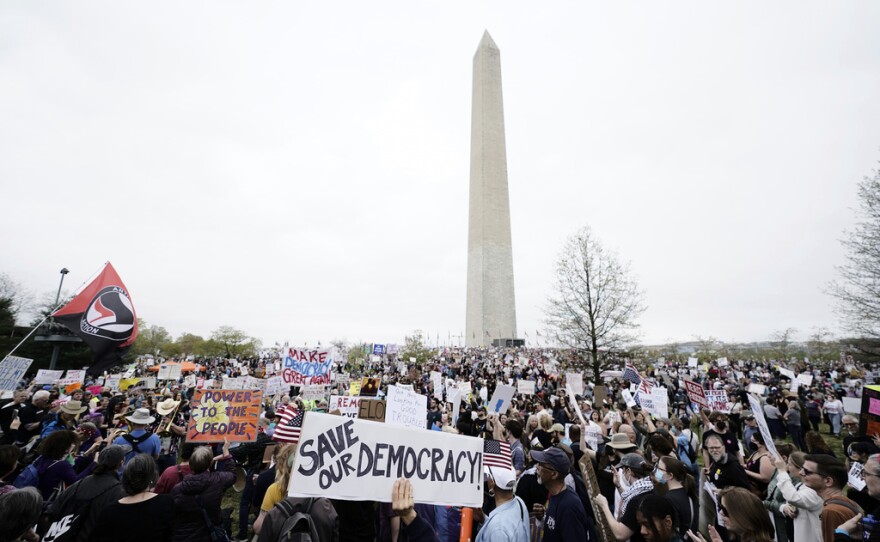
Policy Summary: In recent weeks, members of the Trump Administration have made remarks regarding the punishment of protesters and the prosecution of perceived “hate speech.”
During a small outing by President Trump and a small group of officials at a public restaurant in Washington, D.C., the President was met by a small group of protesters. The protesters chanted “Free DC” and “Free Palestine” and also “Trump is the Hitler of our time!” The protesters were ultimately removed. However, the President later suggested the protesters should be charged under a racketeering statute since he said one of the protesters was a “paid agitator.” It is unclear where the President receivedthis bit of info or if it is even true. After this incident, Deputy Attorney General Todd Blanche gave an interview where he defended the idea of prosecuting protesters.
In the weeks after the killing of conservative commentator Charlie Kirk, numerous public and privatefigures made comments about Kirk that could have been perceived as insulting and vulgar. Attorney General Pam Bondi then came forward and promised to prosecute instances of “hate speech.” Subsequently, after much criticism, Ms. Bondi tried to clarify her remarks and stated that she would only pursue cases that came with a threat of violence.
Finally, before he departed for a visit to Britain, President Trump suggested that journalists who were critical of him and his presidency should be prosecuted. He also implied that critical coverage of his administration could be a form of hate speech.
Policy Analysis: The theme from this Administration about prosecuting protesters and trying to classifycritical articles from journalists as “hate speech” represents a dangerous road that this Administrationshould not go down. First, the prosecution of protesters is not supported by the current laws of the United States. And, this Administration’s conception of what is truly “hate speech” is not how that category of speech has been traditionally viewed.
Under the First Amendment’s protection of free speech the right to protest is protected with some limitedexceptions. Under that protection is the underlying principle that the government may not silence views and viewpoints with which it disagrees. In the 1989 Supreme Court Texas v. Johnson the Court stated, “If there is a bedrock principle underlying the First Amendment, it is that the government may not prohibit the expression of an idea simply because society finds the idea itself offensive or disagreeable.”
Even with the tragic killing of conservative commentator Charlie Kirk, that incident should not serve as the reason why our First Amendment protections should be quietly put away. But the President and others in his Administration are trying to silence dissent for the Administration’s policies and find waysto get around and ignore what the First Amendment provides.
In Todd Blanche’s interview he tried to characterize protests as inflicting “harm, terror” and “damage”but this is simply not true. There were no violent altercations or physical disruption. What is likely goingon is that the deputy attorney general and the president were trying to criminalize the protests in order tomore easily dismiss them and maybe have those who organized and funded the protests held criminallyliable.
The Supreme Court has issued decisions that have held that the government cannot punish speech simply because it is controversial and offensive. And the Court also has weighed in on organizerliability for protests. In NAACP v. Claiborne Hardware Co. and Counterman v. Colorado, the Supreme Court issued rulings that said protest organizers could not be held liable for the violent acts of a protester and that a punishment is only warranted if a protester posed a “true threat” to another physical person. For President Trump, Attorney General Bondi and Deputy Attorney General Blanche, their comments about going after protesters are simply wrong and go against established law in the United States. Government officials should not be commenting or talking in this misleading manner, especially when two of the three persons are trained lawyers.
Finally, “hate speech” is a rather complex free speech issue because of some confusion as to what it isand if “hate speech” is protected as free speech under the First Amendment. Under the First Amendment, hate speech is not a legally recognized category in the United States. While it may be a recognizedcategory in other countries, it is not here in America. Hate speech in the U.S. can be understood as anumbrella that encompasses different types of vulgar or hateful speech with some types protected under the First Amendment and others not protected. Those that are not protected as speech are those that posetrue threats of imminent physical violence, harassment and speech that is obscene (in a sexual manner).So even though there is speech that is demeaning to race, gender, religion or other grounds, it cannot be punished because those kinds of words and utterances are meant to contribute to public policy debates no matter how vulgar the language may be. That speech is protected by the First Amendment. Viewed in this context, AG Bondi’s threats to punish hate speech is not legally feasible and she was wrong to threaten prosecution. Even if we do not agree or like with what is being said Ms.
Bondi has no legal justification to try and target protesters for what they said in the aftermath of the Charlie Kirk killing. She may have simply been trying to vent her frustration at what was being said about him or trying to mischaracterize those statements as violent speech when that was not the case.And, for President Trump to try and characterize a journalist’s criticism of him as hate speech is foolish. Criticism of an Administration’s policy goals is not hate speech at all but simply ordinary debate of public issues that a President should expect. As Justice Samuel Alito stated in 2017, “the proudest boast of our free speech jurisprudence is that we protect the freedom to express the thought that we hate.”
We hope that this AdministraGon and other government officials would have a clearer understanding intheir interviews and comments about how Free Speech protecGons under the First Amendment works.
Engagement Resources
Freedom Forum – arGcle on Supreme Court cases dealing with organizer liability for protests. FIRE(FoundaGon for Individual Rights & Expression) – arGcle on the concept of hate speech. ACLU – (American Civil LiberGes Union) – arGcle from non – profit group on free speech and government retaliaGon.