
Part 1 of 2: This part covers How the Weather Is Changing the People’s Life.
Part 2 of 2 will cover how the Summer Wildfire Spread Across France and Spain.
Florentines say July has been unusually hot this year. Outside, temperatures climb to 105 degrees Fahrenheit. It is not much cooler indoors. Tommaso, the son of the woman who owns the apartment where we are staying, says summers seem to be getting hotter every year. The heat is impossible to ignore. Inside the Uffizi Gallery, the air feels heavy and the temperature is high. Because of the oppressive heat, the museum is closing for two days to visitors without advance reservations. Standing among some of the world’s greatest masterpieces, I find myself wondering how the collection is protected under such conditions. Can extreme heat really have no effect on paintings that have survived for centuries?
Few restaurants seem to have air conditioning. Most rely on fans, and I notice more of them everywhere. I cannot help thinking about the cooks working in restaurant kitchens. How do they manage their jobs without AC, beside blazing stoves, when the entire city is sweltering?
We go to the Boboli Gardens early in the morning, carrying a backpack with two bottles full of cold water, trying to return to the apartment before the heat reaches its peak. Our apartment does have air conditioning, and we keep it running 24/7. But it does not cool the rooms very much. The building is in the historic center, not far from the Galileo Museum and the Uffizi, and the old electrical wiring simply cannot handle the amount of power needed to run the air-conditioning units at full capacity. Tommaso says they have the same situation with AC all over the city. During the day, we and our neighbors keep the exterior shutters closed to preserve whatever coolness remains inside. It really helps. Our favorite refuge for a cup of coffee and a pastry becomes Caffè Concerto Paszkowski. At least there, it is cool (also, they serve cappuccino after 11am without batting an eyelid, well, not avoiding an inoffensive joke about the cappuccino timing). The heat is not confined to the daytime. At night, temperatures remain pretty high, and the city never quite manages to cool down. And yet Florence remains charming. Even exhausted by unbearable heat, it is still Florence — magnificent, elegant, and utterly enchanting.
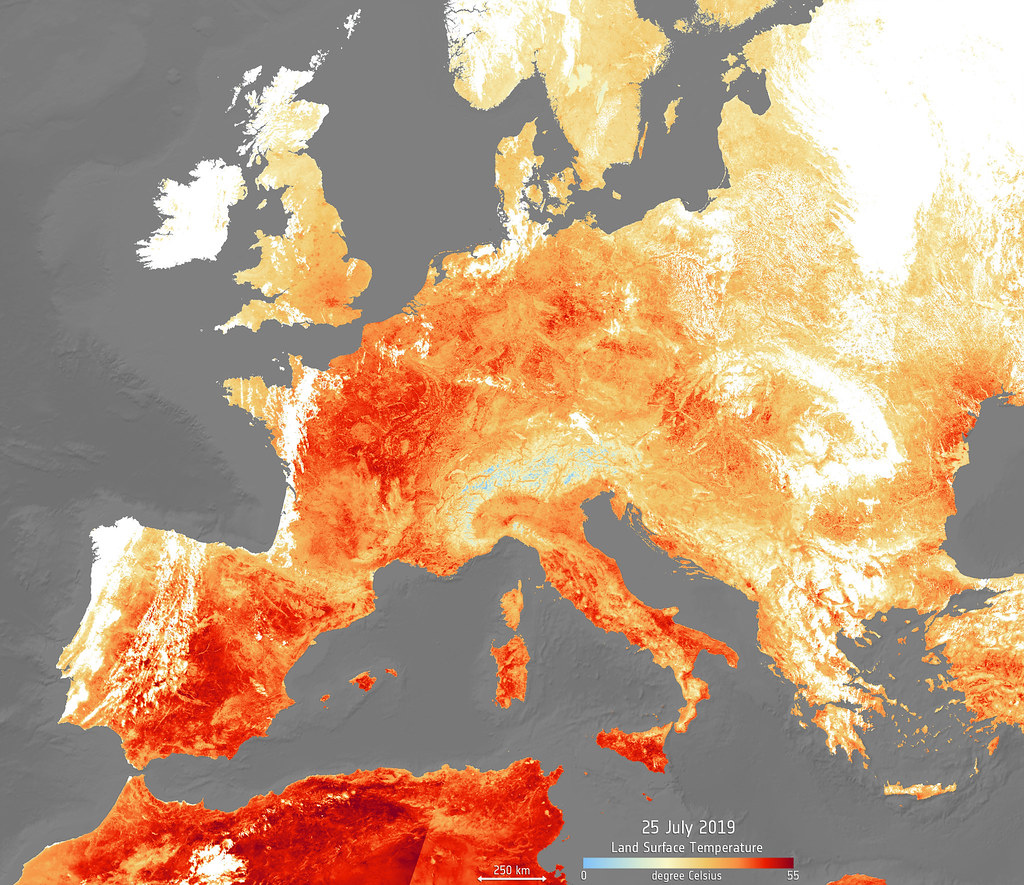
This summer, however, the experience of heat in Florence is part of a much larger European story. June 2026 was the hottest June on record in Western Europe, and a wave of extreme temperatures swept across much of the continent after another severe heat episode in May. The extraordinary temperatures have also reignited a familiar European debate: should air conditioning become a necessity rather than a luxury?
Around 3.5 billion people worldwide live in regions with high temperatures, yet only about 15% of them have access to air conditioning. In Europe, air conditioning is installed in only about 20% of buildings, compared with 76% in North America and more than 90% in Japan. The numbers vary across Europe. About 48% of Italian households have air conditioning, compared with 43% in Spain and 65% in Greece. In Germany the figure is only about 3%, in Britain — 5%, and in Poland — 8%. For generations, much of Europe simply did not need air conditioning.
Many European cities historically had relatively mild summers, and buildings were designed accordingly. In places such as London, Amsterdam and Berlin, summer temperatures traditionally hovered around 68-77°F. Heat waves occurred, but they were less prolonged and less severe than the extreme heat Europe is increasingly experiencing today. Brian Motherway of the International Energy Agency has said that “there is simply no tradition of using air conditioning in Europe,” because until recently there was no urgent need for it. Air conditioning therefore was regarded more as a luxury than a necessity. Energy is also more expensive in many European countries than in the United States, while incomes tend to be lower. Also, much of Europe’s housing stock is old — in England, for example, one in six homes was built before 1900. Retrofitting historic buildings with modern cooling systems can be difficult, expensive, and in some cases, politically complicated.
There are also environmental and regulatory concerns. European regulations restrict certain refrigerants because of their impact on the climate, while building codes and landlord-tenant rules can make the installation of AC systems more complicated. But the climate is forcing the conversation to change. This summer, demand for ACs surged by more than 300% compared with the previous year. Between 2019 and 2024, AC production in Germany increased by 75%. Sales have also risen sharply in France, Spain and Britain. Online sales in Spain and France reportedly increased by 108% as early as May.
In France, the question has even entered the political arena. Marine Le Pen, a far-right politician and a member of the National Assembly who is running as a candidate in the French 2027 presidential elections, has revived a proposal for a large-scale national air-conditioning program, while National Rally lawmaker Jean-Philippe Tanguy has proposed spending €20 billion by 2030 on improving cooling systems, renovating buildings, improving insulation and installing 40 million air conditioners. The proposal has drawn opposition from the left. Jean-Luc Mélenchon has argued that Europe should look for alternatives to widespread air conditioning, warning that artificial cooling contributes to the climate crisis. At the same time, the French government has allocated €100 million for the urgent installation of air conditioning in hospitals, amid concerns that essential medical facilities cannot safely operate in extreme heat without adequate cooling.
Britain has faced its own problems, including disruptions to medical equipment, cooling systems and IT infrastructure, school closures and failures affecting MRI scanners. London Mayor Sadiq Khan has said that installing air conditioning in schools and hospitals may eventually become unavoidable.
The European Commission has largely avoided taking a position for or against air conditioning, framing the issue instead as part of a broader strategy involving building renovation, energy efficiency and housing. For now, Europeans are adapting in whatever ways they can: closing shutters, seeking shade, changing their schedules, installing fans, closing businesses during day-time siesta (a rest period taken in the early afternoon), and, increasingly, turning to air conditioning.
But the question is no longer whether Europe will have hot summers. It is how hot — and how often — they will become. Even cities built to absorb the heat of the Mediterranean summer are struggling with temperatures that linger well into the night. The places that were never built for extreme heat are now among those most affected by it. Museums, restaurants, apartments and even hospitals are being forced to confront a reality for which much of Europe was never designed. My friend Emma’s daughter gave birth in northwestern Germany in June. Emma said the heat in the hospital was unbearable, even in the delivery room and maternity ward.
The debate over air conditioning may therefore be about much more than comfort. It is becoming a question of how Europe will survive in a warmer climate — and how much it will have to change to remain livable. The summers are changing, and Europe is having to change with them. The air conditioners are coming. The fans are multiplying. The shutters are closing earlier. People are waking up earlier and staying indoors longer. And perhaps that is the clearest sign that something fundamental has changed. The question is no longer whether Europe will become hotter. It already is. The question is what kind of Europe will emerge when extreme heat is no longer an exception to summer, but one of its defining features.
Take action
- Actions for a healthy planet, https://www.un.org/en/actnow/ten-actions
- Here are eight simple ways you can fight climate change today, https://www.unep.org/news-and-stories/story/here-are-eight-simple-ways-you-can-fight-climate-change-today
- 9 things you can do about climate change, https://www.imperial.ac.uk/stories/climate-action/
- Energy-Efficient Air Conditioning Tips: Save Money and Reduce Energy Waste, https://www.hitachiaircon.com/us/magazine/ways-to-save-energy-through-efficient-use-of-your-ac