
Summary
Scientists are exploring ways to turn the world’s submarine internet cables into climate-monitoring infrastructure. The infrastructure will be capable of detecting changes in ocean temperature, earthquakes, and deep-sea pressure shifts linked to climate change. The use of existing global infrastructure gives this idea added potential but also raises security concerns when modifying critical internet systems.
Analysis
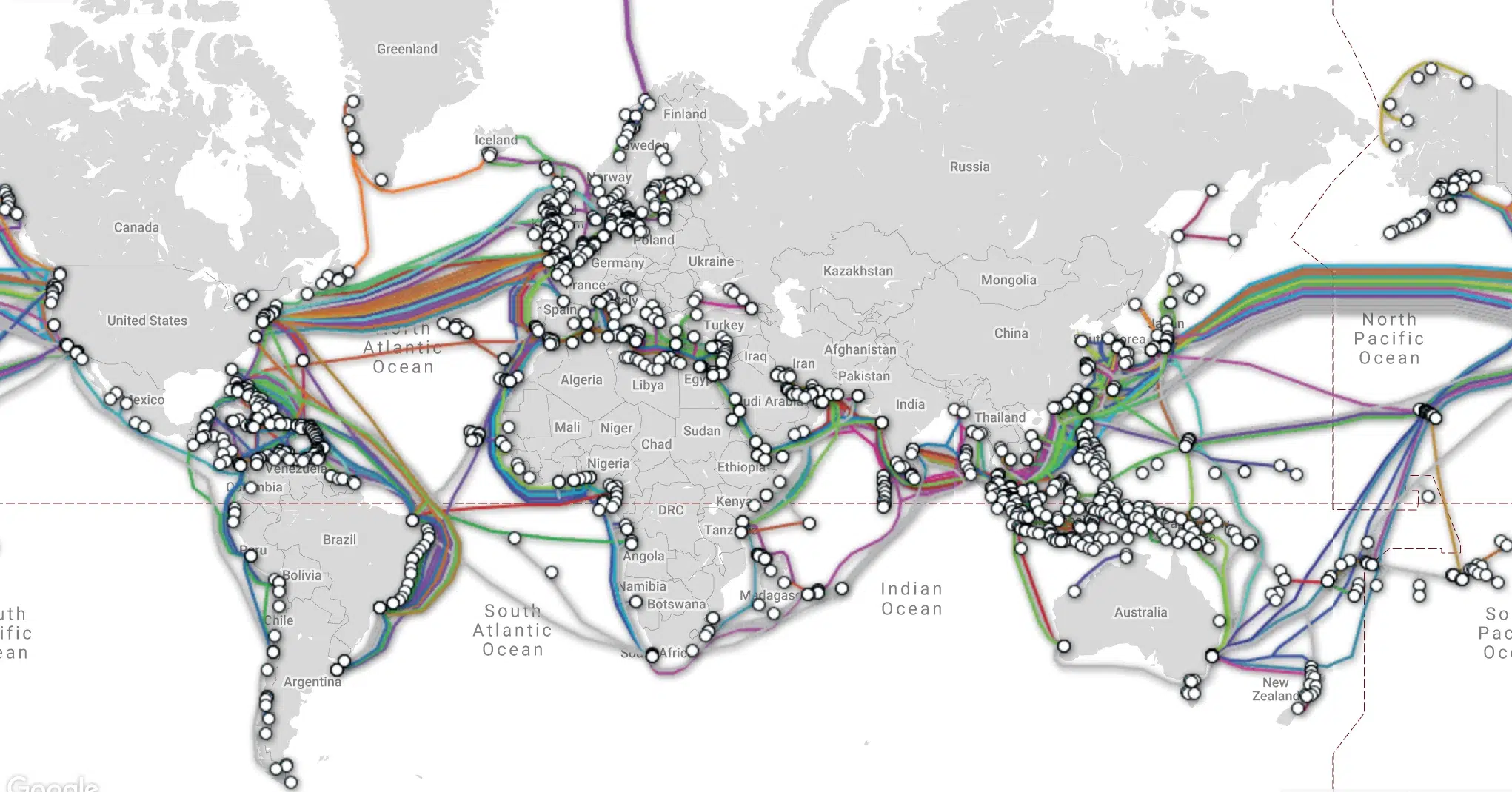
According to the United Nations, there are currently more than 500 commercial submarine cables connecting continents. These cables stretch for around 1.4 million kilometres, making them long enough to wrap around the world multiple times, which is why some scientists are studying their potential for climate monitoring.
Marc-André Gutscher, marine geoscientist at the Geo-Ocean research centre in Brest, France, led a seven-year EU-funded research initiative called FOCUS, which researched how undersea cables could be repurposed as a global sensing network. “We have excellent satellite coverage of the sea surface,” and added, “But deep beneath, where most earthquakes and tsunamis originate, we have very few direct observations.”
The team used a 6-kilometre-long prototype cable laid across the seafloor along the North Alfeo Fault off Catania, Sicily, to study how well it would work. Two techniques were used: Distributed Acoustic Sensing (DAS) and Brillouin Optical Time Domain Reflectometry (BOTDR). In both techniques, a laser sends light through the fibre-optic cable to detect changes in how the light travels, indicating activity on the seafloor.
The results revealed that the technology was able to register the smallest movements on the seabed and measure temperature changes, acting as proof that internet cables can become the front line of climate monitoring.
While the study focused on tectonics, Gutscher shared, “The potential for integrated environmental and hazard monitoring is enormous.” He added, “We are effectively transforming the world’s digital nervous system into an ecological nervous system.”
Other studies have also taken place over the years, like Caltech’s research project led by scientist Zhongwen Zhan. His team used Google’s “Curie Cable” to test out earthquake warning systems.
He said, “This new technique can really convert the majority of submarine cables into geophysical sensors that are thousands of kilometers long to detect earthquakes and possibly tsunamis in the future.”
In Germany, the GFZ Helmholtz Centre for Geosciences in Potsdam and the GEOMAR Helmholtz Centre for Ocean Research in Kiel are setting up research infrastructure SAFAtor(SMART Cables And Fiber-optic Sensing Amphibious Demonstrator) to monitor the oceans.
While the technology and potential are there, implementation has a number of challenges, including physical access, security risks, and multi-jurisdictional coordination. Because underwater cables pass through international water and national territories, programs will require internal agreements across multiple governments. There is also the risk that modifying cables can interfere with the reliability of telecommunications. These cables carry over 90% of the world’s internet traffic, so it’s easy to see why policymakers might be hesitant to make changes or expose sensitive infrastructure to new vulnerabilities.
As a result, governments will need to create an international telecom policy to protect national security and promote telecommunications governance.
Engagement Resources
- Could Undersea Cables Act as Early Warning Systems for Environmental Disasters?
- Submarine Cables
- climate change and digital security